Friday, October 26, 2012

Thoughts on Imprecatory Prayer

Normally I don’t blog about sermon topics but this week I’m making an exception.  (You can hear the sermon at the Zoar Church website after 10-28-12.)   

As I interact with people who do not believe in God I’m discovering some of the reasons why.  One primary reason is the perception that “religious” people are violent and hateful.  It is true that throughout the centuries “worshipers” of all types have prayed for God to kill their enemies and some have taken matters into their own hands.  These prayers are called “imprecatory prayers,” meaning “to invoke a curse.”

Believe it or not, some are still praying these kinds of prayers.

In an interview with Alan Colmes, host of a nationally syndicated radio talk show, Wiley Drake, a mega church pastor and former vice president of the Southern Baptist Convention, stated that he prayed for God to kill the president of the United States.  When asked how he could justify such a prayer he said he was “asking God to enforce imprecatory prayer.” (For more than you care to read or hear just google Wiley Drake.)

So what does the Bible actually have to say about imprecatory prayer and why even talk about it?

Well, the “why talk about it” question goes back to what I said about those who have great difficulty embracing belief in God.  The truth is some “Christians” (as well as other religious adherents) have poorly represented their faith.  So I write in the hopes of exposing the other side of the coin.

For the “what the Bible says” question, please be patient and keep reading.

In the Old Testament most imprecatory prayers are petitions for God to exercise lex talionis (the law of retaliation) on behalf of the writer… most often speaking for the Israelite nation.  The law of retaliation is found in Exodus 21:23-25.

23 …if there is serious injury, you are to take life for life, 24 eye for eye, tooth for tooth, hand for hand, foot for foot, 25 burn for burn, wound for wound, bruise for bruise.” (NIV)

As primitive as that seems, this law was actually put into place to restrict violence.  The law stipulated that an offended person could only do to their enemy what the enemy had done to him.  Before this law was given to the Israelites there was no real restraint on violence in the world.  If you killed my mule I might burn down your barn with all your livestock in it. 

So, for example, in Psalm 137:8-9 the psalmist, as a part of his prayer, cries out…

O Daughter of Babylon, doomed to destruction,
    happy is he who repays you
    for what you have done to us—
he who seizes your infants
    and dashes them against the rocks.

No doubt the writer is imploring God to exercise retaliation on behalf of the people.  What the Babylonian invaders had done to the Israelite children, the Israelites look forward to doing to theirs.

But is this where the biblical revelation stops?  Is this all we’re left with?  You slap me and I slap you?  You kill my child and I kill yours?

The answer is no!  At least not for followers of Jesus.  Followers of Jesus Christ look at everything through the lens of his teaching and example, what Jesus said and did. 

In the Sermon on the Mount, the most influential teaching every shared with human kind, Jesus addresses the law of retaliation.  In a sense he gives us and upgrade!

38 “You have heard that it was said, ‘Eye for eye, and tooth for tooth.’ 39 But I tell you, Do not resist an evil person. If someone strikes you on the right cheek, turn to him the other also.  40 And if someone wants to sue you and take your tunic, let him have your cloak as well. 41 If someone forces you to go one mile, go with him two miles. 42 Give to the one who asks you, and do not turn away from the one who wants to borrow from you.  43 “You have heard that it was said, ‘Love your neighbor and hate your enemy.’  44 But I tell you: Love your enemies and pray for those who persecute you, 45 that you may be sons of your Father in heaven.
(Matthew 5:38-45 NIV)

The teaching of Jesus moves us to a higher ethical and moral plane.  The biblical revelation finds its completion in Jesus. 

In the 1963 edition of The Baptist Faith and Message there is a line that says, “The criterion by which the Bible is to be interpreted is Jesus Christ.” (Herschel H. Hobbs, ed. The Baptist Faith and Message, Nashville: Covention Press, 1971 p.18.)  That line was removed from the 2000 edition but some Baptists still believe that it contains tremendous wisdom.

For followers of Jesus everything; every teaching, every Bible passage, every philosophy, every theology, is processed through the filter of the teachings and example of Jesus Christ.  What Jesus said and did is ultimately authoritative.  This is central to Christianity!  

That means that we are not free to model our prayers after Old Testament imprecatory prayers.  Like Jesus’ original disciples we ask him to teach us to pray.  And he teaches us to say, “forgive us our sins and we forgive those who sin against us.” (Matthew 6:12)

Thursday, October 18, 2012

Is Beauty good evidence for God?

Give me a minute to describe a scene for you.  Near a little mountain community called Valle Crucis, the Watauga River descends rapidly for about a quarter of a mile.  Within that stretch the river spills over natural dams and squeezes between large boulders to form deep pools of cold clear water.

In those pools (most of the time at the very bottom) trout hold still, waiting on their next meal to come rushing into their feeding lanes.

Several days ago I stood near one of those deep pools in hopes of tricking one of those trout into believing that the imitation fly floating into their watery home was not an imitation.  And on that particular day I was successful on several occasions.  The biggest success was an 18 inch rainbow.  (Don’t worry, I released it along with the rest I caught that day.)

Admittedly, most of what I just wrote was me bragging about catching a nice fish; a shameless effort to make my friends jealous.
But there is another point… I hope.  Standing there in the river, having just released the rainbow, I watched it blend seamlessly into to the water like a chameleon.  Then I looked up at the colors of fall all around me.  The river, the rocks, the multicolored trees created a scene no artist could fully capture.  I can only describe it as beautiful.

Which leads to the other point.  For centuries philosophers, theologians and artists have argued that the reality of beauty is a legitimate and convincing argument for the existence of God.  The theory is that the existence of beauty, the intricate, compelling symmetry we find in everything from biology to mathematics to music is strong evidence that there must be a creator.
However, many would say that the argument doesn’t hold water.  Richard Dawkins, a prominent atheist, has made the counter argument.

I have given up counting the number of times I receive the more or less truculent challenge: 'How do you account for Shakespeare, then?'  (Substitute Schubert, Michelangelo, etc. to taste.)  The argument will be so familiar, I needn’t document it further.  But the logic behind it is never spelled out, and the more you think about it the more vacuous you realize it to be.  Obviously Beethoven’s late quartets are sublime. So are Shakespeare's sonnets.  They are sublime if God is there and they are sublime if he isn't.  They do not prove the existence of God; they prove the existence of Beethoven and of Shakespeare.  A great conductor is credited with saying: 'If you have Mozart to listen to, why would you need God?' (The God Delusion, Mariner Books: 2008, p. 110)

I tend to agree with Dawkins.  The fact that there is beauty in our world is not convincing proof that God exists.  Beauty (symmetry, balance, harmony) could be the natural result of evolutionary development apart from God.  The simple fact that beauty is there does not mean that God is there.

Besides, when you argue for the existence of God based on the reality of beauty, then what do you do with all that is not beautiful?  Much of what we see all around us is not beautiful.  It is ugly! 

The ugliness of hunger and abuse and oppression and injustice is real and it does not inspire a sense of transcendence and reverence.  It inspires a whole different set of sensations that encompass everything from helplessness to guilt.

But here’s my question (and I guess an argument to which I invite your response).  How does Dawkins know that Shakespeare’s sonnets are sublime?  How do human beings intuitively know what is beautiful and what is not?  How is it that we have the innate ability to recognize beauty?  If we are simply part of the natural development of the universe then we should have no real point of reference.  Right?
Why should a blooming rose inspire a totally different sensation than hair growing out of somebody’s nose?  Why should we know that a child smiling is beautiful but a child starving is not?  In fact, if Darwinian evolution (with no greater purpose) is all there is, then some of the most atrocious injustices in this world… starvation, brutal oppression and disease are simply natural (and healthy) examples of the survival of the fittest.

But we all know that we do have a point of reference, don’t we?  We are all appalled by the injustices of this world.  We all grieve over starvation, homelessness, abuse in all forms; the list goes on and on.  And I would argue that the innate understanding that some things are beautiful and some things are ugly, that some things are inherently good and some things are inherently bad, that some things are just and some unjust has been infused into our DNA.  The question is, who did the infusing?

I have great respect for my friends who do not believe in God; who have, to this point, been unable to embrace the possibility of a dimension outside of the one in which we now live.  Many of them have given “spirituality” more thought than a lot of religious people I know and have simply arrived at a different conclusion.   

But I respectfully disagree with those friends.  I believe deeply that there is a creator, we call that creator God.  I believe that God has given us the intuitive capacity to know what is and is not beautiful, good and just.  I do not know of any other viable explanation. 

The next time I’m fishing or walking through the woods or watching the sun set, I will see beauty and recognize it.  I can only conclude that I will see beauty because there is a beautiful God.

Thanks for reading with an open mind.

Tuesday, October 2, 2012

Is Jesus a Republican or a Democrat?

“Is Jesus A Republican Or A Democrat?”  It’s not only a compelling question, it’s the title of a book by Tony Campolo.  Campolo does a good job of stating the positive and negative distinctives of each political party.  

The Republicans emphasize individual responsibility, a trait lacking in many of our citizens.  The Democrats emphasize collective responsibility, a trait lacking in much of our society.  The Republicans tend to be soft on the abuses of big business and the Democrats tend to be soft on traditional moral values.


A lot of people say that Jesus would support the platform of the Republican Party.  Others argue that Jesus would be a strong Democrat.  Both groups are passionate about their convictions.  Both groups are confident in their conclusions.  And both groups are, in my opinion, wrong!

I find it fascinating that during a time when political upheaval was pervasive, when his disciples expected him to be the next big political figure, when the entire Jewish community was looking for a Messiah (a political leader) that would overthrow the Roman government, Jesus refused!

Why?  Why didn’t Jesus lead a revolt against the Roman government and set up a “righteous” kingdom?  Why didn’t he kick out the corrupt religious leaders and establish a new regime?  Maybe it’s because Jesus actually knew how real change, real transformation happens.  (By the way, since Jesus was the most influential movement leader who ever lived, perhaps we should pay close attention to what he said and did.)

Perhaps one thing we learn from Jesus is that global transformation never happens from the top down.  It always happens from the bottom up.  Incidentally, as a matter of well documented historical record, Jesus Christ launched a movement that did indeed change the world. 

How did it happen?  According to the eye witnesses of Jesus’ ministry, he did it by transforming human hearts.  Jesus changed (and, in my opinion is still changing) the world by changing people.  I believe that Jesus is transforming humanity by transforming humans.  He is making all things new by making people new… “born again.” 

Unapologetically, Jesus invites human beings to follow him.  He is the one who offers and gives forgiveness, new life and a new kingdom.  Over the last 2000 years, millions have responded to that invitation.  Every credible student of ancient history agrees that those who believed in Jesus Christ literally changed the course of human history.  Do you want to change your world?  Then take Jesus seriously!  Trust him!  Trust him enough to follow his teachings and example!

Today, around the globe, millions are still responding to his invitation.  Millions are still trusting him with their very lives, with the way they live.  And the world is still being changed, rescued, redeemed.  According to the Bible, someday our redemption will be complete.

I suppose (actually I believe) that republican and democrat politicians make a difference.  Voting is important.  The political process is not pointless.  But of all the good that the political process does, it does not transform the politicians or the people who elect them.  In my opinion, only Jesus can do that.

Tuesday, September 25, 2012

Brief thoughts about a fleeting moment of transcendence

Looking into the predawn sky from the comfort of my recliner a few days ago, I experienced what I can only describe as an encounter with God.  You may be able to relate, maybe not.  Perhaps you too have been surprised by those fleeting moments when you actually feel the presence of the divine. 

The earth didn’t shake.  I didn’t hear God’s voice.  But somehow it was “real” to me. 

In these moments (I’ve had others) fleeting as they are, I simply sense the nearness of God.  I find myself grasping for words to explain it.  It’s not that God is necessarily any nearer than he always is, but in that moment, like a mist that collects on the hairs of my forearm or the warmth of the morning sun on my face, I feel his nearness.  In that moment his presence is palatable.  Maybe you can relate.

Maybe you know exactly what I’m talking about.  Sometimes in quiet reflection, sometimes in the hurried activity of the day, sometimes looking out at the ocean, sometimes sitting in traffic; the “optimum conditions” for the experience are really hard to predict and even harder to manufacture.  But it happens; unpredictably, unexpectedly, unavoidably, it happens.

Human beings, for some reason (some would say some unexplainable reason) have been known to experience what Christopher Hitchens, who recently died, called “transcendent or luminous” moments.  Of course Hitchens, a very well known atheist, would not attribute those moments to the activity of God.  As a non-believer he had to explain them using the only explanation at his disposal; kind of like a mechanic who is forced to try to fix a problem without the proper tools.  Hitchens attributed those moments to some kind of chemical reaction in our brains.

I have great respect for Hitchens.  He was an intelligent person.  He was a person who had actually given a lot of thought to life and human existence.  He had reflected and theorized about why we do what we do, think and feel what we think and feel, experience what we experience.  But in this case, I don’t think he had a very good answer.

I would argue that the transcendent moments are just that… transcendent… moments when we transcend.  Moments when the curtain that normally divides our dimension from God’s (although he occupies all dimensions – like I said, it’s hard to explain) gets pulled back and we get a glimpse into the heart of our creator.  In those moments the beauty is breathtaking.

As a believer I would recommend two responses to these fleeting moments of transcendence.

One, don’t depend on them.  There’s a reason I refer to these moments as “fleeting.”  They don’t last long.  In my experience, not only are they fleeting, they are rare.  I’ve been a pretty serious follower of Jesus Christ for around 30 years and I would guess that during that time I’ve experienced “transcendent moments” maybe a total of 30 minutes (and that might be a generous estimate).

So if I choose to be committed to Christ only when I “feel” his presence I miss out on a lot of opportunities to worship him, serve him and share my faith with others.  As I write this blog I actually feel pretty blah.  I would much rather be in a river fly-fishing.  I’m pretty sure I would be more likely to have a transcendent moment there than sitting here in my office. 

Two, don’t disregard them.  I think this is a very real possibility and it is sad.  I believe that God actually gives us these moments as gifts to be received and treasured.  But here’s the problem (at least it’s a problem for me).  I think I might miss some of those moments simply because I ignore them. 

Could it be, especially in our Western world, where we think through everything and feel compelled to explain everything and be able to qualify and quantify everything, we can actually miss out on some of the best things… like moments with God?  Could it be that even those of us who claim to be believers have a default mode that is more like Christopher Hitchen’s?  We give our brains credit for something God did.   

Just a couple thoughts to ponder. 


Thursday, September 13, 2012

Was the Earth Created in Six –24 hour– Days?


“Do you believe that the earth was created in six –24 hour– days?”  Recently someone asked me that question.  I’ll get to my answer in a minute.  But first, let’s think about the question.  It is not inconsequential.


Followers of Jesus believe that the Bible was inspired by God.  In other words, when I hold a copy of the Holy Bible in my hands I’m holding words that, in some very real but deeply mysterious way, came to us from God.  This is central to Orthodox Christianity.

But many people are made to feel like heretics because they believe that the first two chapters of Genesis are to be understood more as a poetic account of creation than a literal one.  Some are drawn to the person and teachings of Jesus Christ but are told that they can’t believe in him and become one of his followers because they believe the earth is closer to six billion years old than six thousand years old.

On the other hand, some people are made to feel intellectually inferior because they do believe that God created the world in six days.  Subtly or not so subtly, directly or indirectly, they are told that no one with a developed understanding of our universe could hold to the archaic belief that the earth is relatively young.  Which is just another way of telling a person that he is not very smart.

I would like to make two suggestions.

First, we make Jesus Christ the foundation of our faith.  This is what theologians refer to as High Christology or the Centrality of Christ.

In college I had a friend who told me that if I didn’t believe in a six day creation then I couldn’t be “saved.”  With all due respect to my friend, I think that if your faith depends on a certain interpretation of the creation story then your theology elevates creation to a place that should be reserved for Christ.  The foundation of our faith must be Jesus Christ and him alone.  

Throughout church history (at least until fairly recently) there has been room for diversity and disagreement in the Christian community, with Christ as the foundation of our faith.  C.S. Lewis, one of the most respected theologians/philosophers from the twentieth century, held to an “old earth” understanding of creation.  Check out chapter five (The Fall of Man) in The Problem of Pain. 

Honestly, if Lewis was alive today I doubt he would get many invitations to speak in evangelical churches.  Maybe we need to make sure we are still building on the right foundation.

Secondly, we make a commitment to intellectual humility.  I think one of the most profound passages in the Bible is found in Isaiah 55:8-9.

“For my thoughts are not your thoughts, neither are your ways my ways,” declares the LORD. “As the heavens are higher than the earth, so are my ways higher than your ways and my thought than you thoughts.” 

Perhaps a paraphrase of that passage could read.  “You can’t begin to figure me out, so how about practicing a little intellectual humility.”

What if we applied this to both sides of this issue?  If I work off of the assumption that God’s way are far above mine, then I might be more open minded about the creative activity of God.  I might not be as quick to determine how long it took the God of the universe to create the earth.  Perhaps I would be willing to entertain the possibility that God could have created in six days… or 4.5 billion years. 

So, you’re waiting to hear my answer to the question.  Are you ready for it?  I said, “I don’t know… I wasn’t there.”

I wasn’t being sarcastic or trying to be funny.  I was quite sincere.  I don’t know exactly (or even remotely) how the creator of the universe created, because I was not an eye witness to his creative activity.  All I have is the creation account recorded in Genesis and I don’t want to be intellectually arrogant enough to claim that my interpretation of the passage is the only possible one.

Someday when I get to heaven, if I care enough to ask God about it, he may say something like; “O yea, I created the world is six days and did it so that it appeared to be 4.5 billion years old.”  To which I will respond, “Father, that is so cool!”

Or God may say, “O yea, I actually created the world in 4.5  billion years.  Then I inspired the Hebrew writer to communicate my beautiful creative activity through poetry.”  To which I will respond, “Father, that is so cool!” 

Either way is fine with me.      

Friday, September 7, 2012

Two Philosophies about Combating Poverty… and a Third Way.

Poverty in America is real.  I think most people agree with that statement.  Statistical evidence seems to confirm it. 

The National Poverty Center at the University of Michigan has studied the history of poverty in the U.S.  According to their research the poverty rate in the 1950’s was 22.4 percent; around 39.5 million people.  Throughout the 1960’s and into the early 70’s the rate declined to a low of 11.1 percent.  Then in 1980 it began to rise again.  By 1983 the percentage of poor people in the U.S. was 15.2 percent.  In 2010 it was 15.1 percent; 39.3 million individuals.   

Information from the U.S. Census Bureau helps make this percentage more concrete, and frankly more potent for me.  According to the 2010 census there are more than 16 million children under age 18 living in poverty in our country. 

Poverty is real.  It impacts millions of U.S. citizens.  In one way or another, poverty touches the lives of every American citizen.  So, two questions – What do we do about it and how?

The Bible is pretty clear about God’s heart for the poor.  Included in the law code that the ancient Israelites were to follow were very clear instructions about how to provide for the poor. They were instructed to give interest free loans to poor people and to especially care for orphans and widows (Exodus 22:22-27).  They were to leave some produce in the fields for the landless poor to harvest (Exodus 2310-11, Leviticus 19:10 & 23:22).  Property that went into foreclosure was to be restored to the original family owners at the Year of Jubilee (every fifty years).  Debts were to be canceled and indentured slaves were to be released every seven years (Deuteronomy 15:1-15).  (I wish we still had the debt canceling thing going!)

During his ministry Jesus cared for the poor and taught that his followers were to do the same.  In fact, in Matthew 25 Jesus describes a time when he will render judgment on those who claimed to be his followers.  Those who failed to care for the poor, the homeless, the sick and the imprisoned would be exposed as false devotees.  In that passage Jesus even tells them that when they failed to care for “the least of these” they actually failed to care for Jesus himself.  In other words, Jesus identified with the poor and marginalized.

The answer to the “what” question is pretty clear.  What do we do about poverty?  We fight it.  We combat it.  We try to eliminate it.  Then that leaves the “how” question.  And that question is harder.

There are two prominent philosophies (and resulting strategies) for combating poverty.  I think both have some merit and both need to be scrapped for a different “third way.”

Perhaps we can describe the first philosophy as a passive approach. 

This philosophy reflects the sincere belief that, in order for the poor to gain what they need most – self esteem or a sense of accomplishment – they need to be given the opportunity to achieve on their own.  It is possible to hurt poor people more than we help poor people by trying to help poor people.  In other words, the only real way to help poor people is to let them help themselves.  Get out of the way and let those who want to succeed, succeed! 

Like I said, I think this idea has some merit.  There is some truth to it.  One of the things a person needs most is a feeling of accomplishment.  Success breeds success.  I get that. 

However, there are drawbacks to this philosophy.  It fails to take a lot of reality into account.  For instance, it doesn’t address the reality of generational cycles; the fact that we all tend to repeat what we learn, even when what we learn is hurtful to ourselves and others.  Many who “could do better” and “should do better,” at a gut level have a distorted understanding of what “better” is.

Nor does it address the reality of oppressive systems.  Some people live in places, and are caught up in systems (governmental, cultural, etc.) that actively hold back poor people. These systems are designed to restrain those who really want to defect from the cycle like a prison cell restrains an inmate.

The second prominent philosophy is a more active approach. 

But it is still similar to the first philosophy in that it takes a “hands off” approach to poverty.  (By the way, I know that I’m generalizing a lot.  I’m doing that for the sake of brevity – not very successfully – and clarity.)

The strength of this approach is the willingness to do something to combat poverty.  The “something” is to, in one way or another, give money, goods and services to poor people.

Those who advocate this philosophy know that the poor can’t actually break the chains of poverty on their own.  Sure… there are a few success stories of exceptional people whose level of intelligence, talent and natural ability propel them out of the cycle of poverty like a sling shot propels a rock through a window. 

But they are the exception, not the rule.  And those who are left behind in the poverty cycle outnumber the “success” stories like cars out number pedestrians on a major highway.

However, the tendency of those who support this particular approach is to depend on the power of money.  It’s kind of like the “if you build it they will come” mentality.  This philosophy says “if you spend it they will change.”  (And we all know that change – what the Christian community calls “transformation” is what we all need.) 

But over the years it has become increasingly obvious that the “if you spend it they will change” approach doesn’t work any better than the “they have to do it on their own” approach.

Throwing money at the poverty problem fails to recognize the complexity of poverty as much as withholding money does.  You can’t buy dignity, self-esteem, a sense of accomplishment in a job well done.  The very things we want to give to the poor we can, unintentionally, take away from them. 

You can see the problem!

So the alternative “third way” might be described as a “hyper-active” approach.

The prefix “hyper” comes from the Greek preposition “huper.”  It’s most basic meaning is “over, above, beyond, across.”  It is very versatile and gets translated “on behalf of, in the place of, on account of, for the sake of.”  You get the picture. 

I think the Bible teaches a hyper-active approach to helping the poor.  We can’t be passive; hoping and praying that they find their way out.  We can’t just provide money, goods and services; believing that will be enough.  Actually, we must do more… much more!  We must invest our very selves; not just money but also time, tears, talent, creativity, relational stamina, patience, raw confrontation… the list goes on and on!

Jesus summed it up by teaching that we are to love our neighbors, including our poor neighbors, as we love ourselves.

Let me give you one example and then I’m done.  I have a friend who is a youth pastor.  We’ll call him Ed but that’s not his real name.  He does all the things that youth pastors do and more… much more!  In Ed’s youth group there is a special kid that lives in poverty.  We’ll call him Joe.  Actually Joe not only lives in poverty, he lives in a family where he experiences blatant neglect and border line abuse. 

In my opinion, Ed is taking a hyper-active approach with this kid.  He takes Joe food, clothing, school supplies and other things that he needs.  When things get too rough at home Joe calls Ed and Ed picks him up and takes him out for awhile.  Ed picks Joe up for youth activities and worship services.  Joe is a very bright kid and has the potential to get scholarships for college.  Ed is keeping him on track by helping him learn how to apply for those scholarships.  Ed is also raising money for the fees that Joe will need to apply to schools.  Ed meets with Joe’s teachers and guidance counselors at school because Joe’s mother won’t. 

In short, Ed is pouring his life into Joe’s life.  He holds Joe accountable.  He prays with him. He counsels him.  He chews him out.  He picks him up.  He is doing stuff on Joe’s behalf, sometimes in his place, on his account, for his sake.  Ed is hyper-active for Joe. 

What would it look like if, in our country, we had 16 million Ed’s being hyper-active for 16 million Joe’s? 

Saturday, September 1, 2012

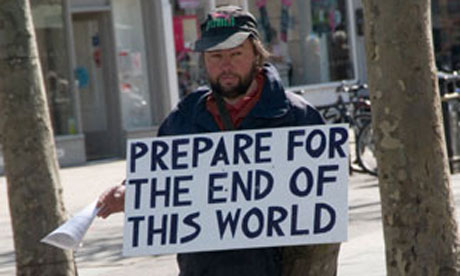
Three reasons not to buy into “doomsday” prophecy

When I was a kid “prophecy experts” would come to our church and roll out long time lines that, to our amazement, revealed how the end of time would unfold.  If I remember correctly, Russia and China were always key players in the inevitable march toward destruction.

I’m not making fun of the prophecy people.  I have great respect for those who remind us that the justice and judgment of God are clearly taught in the Bible and that what the Holy Scriptures refer to as “The Day of the LORD,” the time when God makes the world right and ushers in a new age, is an inevitable event.

What concerns me (and I think it is a legitimate concern) is the way that this biblical teaching gets distorted into a not so subtle message that the church of Christ really can’t fulfill their calling to disciple all nations.  (Matthew 28:19) 

You see, the teaching I grew up with went something like this.  The world is a really bad place full of really bad people and it is getting worse.  It is going to get worse and worse until finally it gets so bad that God has to intervene (the return of Christ) and wipe out all the bad people (which is always “those” bad people) and rescue the few “good” people left (the saved people) from the utter destruction that will rain down from heaven on the really bad world.

What I would argue is that perhaps, maybe, just maybe that's not the most accurate picture or the most healthy, redemptive understanding of what the Bible actually teaches about the end of the age.

I think there are three good reasons not to buy into doomsday prophecy.

1.      I don’t think it is the most biblically accurate picture of the end of the age and the inauguration of a new heaven and a new earth. 

Yes, the Bible clearly teaches that human beings sin and that a sinful world will ultimately be judged and by a righteous God.  (By the way, no one really wants a God that doesn’t judge and bring justice to a broken world.  There is something deep inside every human being that not only knows that the world needs to be set right, but also longs for a God who will do just that.)  But I think it is a misreading of scripture to understand that judgment comes, in some way, because of a failed venture of the church – which is what doomsday preachers tend to preach.

We could have long discussions around this concept and I welcome feedback and pushback, but I think that the popular idea that the world becomes such a terrible place that God has to step in and intervene comes primarily from a misunderstanding of the book of Revelation.  I think we have to remember that Revelation is apocalyptic literature, a genre that gives modern readers a lot of trouble.  At the very least we need to exercise more interpretative humility when reading the book of Revelation.     

However you interpret Revelation, it is important to see it as part of the entire biblical revelation.  Revelation is the end of the redemptive narrative.  The story begins in Genesis with rebellion in a garden but it ends with redemption as the city of God comes down out of heaven.  John, the revelator, hears a voice saying that now the dwelling of God will be with human beings and he will live with them.  They will be his people and God himself will be their God.  And he will wipe every tear from their eyes.  (Revelation 21:1-4)

It is not a picture of the last minute intervention of God after his bride the church couldn’t get the job done.

2.      I don’t think it is a very healthy way for followers of Christ to live in this world. 

In a sense, we’ve decided that we have lost the game before we take the field.  Imagine what it would be like to be on a football team gathered around your coach in the locker room before a big game.  The coach begins his pregame pep talk.  “Guys, here’s the way I see the game developing.  Your opponents are going to become stronger and stronger throughout the game.  Through the whole game you’re going to get beat up.  Unfortunately, we’re going to lose some players along the way.  And the other team is going to outscore you right up till the end of the game.  But don’t worry, just before the last second of the game we have a plan in place to get the game stopped on a technicality and you will be declared the winners by default.  Now let’s go get um.” 

I really don’t think that pep talk will create a lot of enthusiasm.  But that is essentially the speech that a lot of people get every Sunday.  We live in a really bad world that is only going to get worse.   But don’t worry, just before it all falls apart the ones who agreed to the right set of beliefs will all get “raptured” out.

No wonder most people say “no thanks!”

I think there is a more beautiful, more glorious story to tell.  Through the life, death and resurrection of Jesus Christ the victory has already been won.  The redemptive movement of God in this world is in full swing!  We are somehow actually a part of it!  What we do in this world actually matters!  I think that’s a better story.

3.      It’s sort of a copout for the modern church.

Think about it.  If the world is just going to get worse until Christ splits the sky, then why try?  In fact, the thing that makes most sense is to be glad that things are getting worse (which is exactly what I think some “Christians” do without coming right out and saying it).  I mean, if we experience a really great movement of God’s Spirit in our world today won’t that actually slow things down?  The Lord will have to wait a while longer before he steps in and annihilates all his enemies. 

You can see why this topic is not inconsequential!

Perhaps there is a different and better way.  We can embrace the biblical teaching that there will be a time when the curtain closes on this age; when God in his wisdom and love brings justice to our hurting and broken world; when wrongs are righted and wounds are healed.

But instead of embracing the default mentality of inactive spectators, maybe we can rethink our thinking.  Maybe we can embrace a different way of thinking.  Maybe we can think of ourselves as active participants in the unfolding drama of world redemption.  Maybe we can be who Jesus called us to be; missionaries, evangelists in this world.  Maybe we can do what he invited us to do; make disciples of all nations.  

Maybe we can be transformed from doomsday people to new day people; people who believe that we are already participating in God’s new day now and will somehow participate in God’s new day then.